
 801-501-7950
 Login
Login
 Check Rates Now


Today’s live rates
You pick what matters most. Pay more upfront for a lower rate or pay less upfront for a higher rate
- Lowest rate 6.875%
- Balanced cost & rate 7.250%
- Lowest cost 7.500%
Live rates for this program aren’t available right now. Customize your rate to get a free, personalized quote.
Current Mortgage and Refinance Rates in Utah
As of October 18, 2026, the rates in Utah are 7% (7.132% APR) for a 30-year fixed rate mortgage and 6.5% (6.5% APR) for a 15-year fixed-rate loan.
Get a Quote in 2 Minutes: 801-501-7950
City Creek Mortgage Rate History
Explore the graph below to follow the history of City Creek Mortgage rates from May 2020 to October 18, 2026. You can interact with the time frame options to observe mortgage rates over selected periods. This visualization tool is crafted to clearly show the increases and decreases in City Creek Mortgage rates throughout the given timeline.
Sept 21, 2026
1️⃣ Trump Wanted Lower Rates. He Got a Rate Hike Instead.
For months, President Trump has made it clear that he believes interest rates should be dramatically lower. He appointed Kevin Warsh to lead the Federal Reserve expecting a different direction.
This week, he got the exact opposite.
The Fed unanimously raised rates by 0.25%, its first rate hike since 2023, and indicated another increase could still be coming this year.
Why?
Inflation.
The war with Iran, higher energy costs, tariffs and an economy that has remained surprisingly resilient have made the Fed’s job increasingly difficult.
Warsh said it plainly: inflation is still too high and has been for too long.
Here’s what makes this so important: raising rates may eventually help bring inflation down, but it also puts additional pressure on an economy and housing market already struggling with high borrowing costs.
The Fed is trying to put out the inflation fire without starting an economic one.
That’s a very difficult needle to thread.
2️⃣ The 10-Year Treasury Just Hit 5%. Pay Attention.
I’ve said this many times: If you want to know where mortgage rates are going, watch the 10-year Treasury.
This week, it hit 5%.
That’s a big deal.
Mortgage rates followed, with the average 30-year fixed rate climbing to 7.25%; its highest level in 19 months.
The bond market is sending a message that investors aren’t convinced inflation is going away anytime soon.
And until that changes, it’s going to be difficult for mortgage rates to make a meaningful move lower.
The Fed doesn’t directly control mortgage rates. The bond market does much of that work.
And right now, the bond market is saying: we’re not out of the woods yet.
3️⃣ Something Eventually Has to Give in Housing.
This may be the most important story of all.
For years, the housing market’s biggest problem was a shortage of homes.
That’s changing.
Inventory is rising while buyers continue to struggle with affordability. Mortgage rates are hovering near 7.25%, payments remain painfully high and many potential buyers simply can’t make the numbers work.
We’re moving toward a housing market with more homes for sale, but not enough buyers who can afford the payment.
That can’t continue forever.
Eventually, something has to give.
Home prices could soften. Incomes could continue rising. Mortgage rates could fall. Most likely, we’ll eventually see some combination of all three.
I still believe significantly lower mortgage rates will come. But before that happens, inflation needs to cool and the bond market needs to believe it.
Right now, neither has happened
💡Rates & Market Outlook
Bottom Line:
As we are all tired of hearing, we maintain a locking bias.
With the 10-year Treasury hovering around 5%, inflation still elevated, oil above $100 and the Fed now raising rates instead of cutting them, there simply isn’t enough evidence to justify betting on lower mortgage rates.
There will eventually be a time to float.
This isn’t it.
Programs and Resources For Utah’s First-Time Buyers
Utah has several programs and resources to help first-time homebuyers become homeowners.
- Utah Housing Downpayment Assistance: City Creek Mortgage has partnered with Utah Housing Corp to help first-time home buyers who lack sufficient funds to meet the minimum down payment requirements for their loan. By leveraging this program, first-time homebuyers can include the cost of their downpayment into the life of their loan.
- USDA (U.S. Department of Agriculture Rural Development): This program offers home loans with no down payment to eligible buyers in rural areas of Utah. First-time homebuyers must have a credit score of 580, though many lenders ask for a score of 620. There is no down payment required.
- VA Loans: A loan program offered to military, veterans, and surviving spouses (see eligibility requirements). VA loans typically have more lenient terms, do not require a down payment, and do not require mortgage insurance (PMI).
- Conventional Loans: The preferred loan type among first-time buyers when their credit score is above 620. The main advantages include lower downpayment minimums than FHA loans, and the ability to remove PMI insurance once 20% of the loan principal is paid. When it comes to month-to-month payments, if your credit score is above 720, conventional loans are almost always a more advantageous option than an FHA loan.
- FHA Loans: A loan program most commonly used by first-time home buyers with a credit score between 580- 620. FHA loans require mortgage insurance and obtaining a loan requires that your property strictly adheres to local guidelines and regulations. One advantage of FHA loans is they are easily refinanced though FHA streamline refinancing.
The Top 5 Hottest Markets Within Utah
1. Salt Lake City
In 2022, the hottest market within Utah was clearly Salt Lake City. Salt Lake City’s population has been steadily increasing over the past few years, with many people moving to the area from other states. In fact, Utah has been the fastest growing state in the past 10 years, with an urban population increasing by 17% compared to the national average of 6.4%.
Utah’s population increased 9% over the last five years, much of it concentrated in Salt Lake City. This has created a high demand for housing, which has driven up prices. Additional factors that make Salt Lake City a hot real estate market include:
- High demand and low inventory: The demand for homes in Salt Lake City is high, but the number of homes for sale is low. The start of 2023 is seeing a slight tapering off with the average time on the market being 83 days. The limited supply of homes for sale is still causing home prices to rise though. As of January, 2023, the median sales price of a single-family home in Salt Lake County was $559,950 or $336/sq ft. In December, 2022, the median price was $460,000.
- Strong Job Market: Much of Utah’s population flocks to Salt Lake County for work. In fact, nearly half of all jobs in the state and 40% of the state’s population are in Salt Lake County.
- Multiple offers and bidding wars: In 2022, the bidding wars were out of control, and Salt Lake City’s housing market was one of the most overpriced markets in the country. The bidding wars are now over, according to Steve Perry, the president of The Salt Lake Board of Realtors. Salt Lake City is still a seller’s market, however, even as home prices taper off from their 2021-2022 peak.
- Quality of Life: Salt Lake City has a high quality of life, with easy access to outdoor recreation, good schools, and a relatively low cost of living compared to other major cities, such as Los Angeles or San Francisco. This has made it an attractive place for people to live and work.
2. St. George
Saint George, Utah is expected to see one of the fastest growing populations in the country. The population of the St. George metro area is expected to grow from 195,200 in 2022 to 425,700 in 2060, which is an astounding 118.1% projected population growth. This, of course, has created a high demand for housing, which has driven up prices. In January 2023, the median price for a house in St. George was $524,900 or $285/sq ft. In November of 2022, the median price for a house was $387,500.
Strong Job Market: Over the same period of 2022 to 2060, employment in St. George is projected to grow by 113.2%. Personal income per capita is projected to grow from $46,956 in 2022 to $275,955 in 2060. This dramatic increase of population, jobs, and income will result in limited housing and increasing housing prices.
- Warm Weather and Outdoor Recreation: Saint George’s warm weather and proximity to outdoor recreation areas, such as Zion National Park and Snow Canyon State Park, make it an attractive place to live. Many people are looking to relocate to the area, driving up demand for housing.
- Retirement Destination: Saint George is often cited as a top retirement destination due to its warm climate, low cost of living, and access to healthcare facilities. Many retirees are choosing to relocate to the area.
- Limited Supply of Homes Relative to Demand: New housing construction won’t be able to keep up with one of the fastest growing “boomtowns” in the U.S. This will result in a low inventory of homes for sale. This will also result in rising prices for new construction homes.
3. Provo
Like Salt Lake City, Provo’s population has been steadily increasing. The population is 840,000, which is a 2.69% increase from 2022. In 2019, the city’s population was 766,000. This growth has, in turn, created a high demand for housing, driving up housing and rent prices.
As of January 2023, Provo’s hot market has cooled off considerably, though rents are still climbing. Still, its strong job market and population increase make it a city in demand.
- Strong Job Market: Provo has a strong job market, with a focus on technology and education. Companies such as Qualtrics, Vivint, and Ancestry.com have headquarters in the area, and Brigham Young University is also a major employer. This has attracted many people to the area, further driving up demand for housing.
- Low Interest Rates: Interest rates on mortgages are currently low, which has made it more affordable for people to purchase homes in Provo.
- Limited Inventory: There is a limited supply of homes for sale in Provo, which has created a competitive market for buyers. In February 2023, the median price of a house is Provo is listed as $498,950 or $248/sq ft.
- Quality of Life: Provo has a high quality of life, with access to outdoor recreation, good schools, and a relatively low cost of living compared to other major cities. This has made it an attractive place for people to live and work.
- Time on the Market: Homes in Provo were selling quickly, with an average of just 11 days on the market in January 2022, according to the Wasatch Front Regional Multiple Listing Service. However, that has slowed to the current time of 76 days on the market.
4. Ogden
Ogden, Utah is a “picture-perfect postcard town.” Add highly rated schools and a low unemployment rate, and it’s understandable why the city has become a desirable place to live. Although the housing market in Ogden isn’t as hot as Salt Lake City or Provo, it still holds a lot of promise.
- Affordability: Ogden is a more affordable option than some of the other cities in Utah, such as Salt Lake City or Park City. This makes it attractive to people who are looking to buy a home but may be priced out of other areas. As of January 2023, the median price in Ogden was $369,450 or $215/sq ft.
- Proximity to Outdoor Recreation: Ogden is located close to outdoor recreation areas, such as Snowbasin Ski Resort and Pineview Reservoir, which makes it attractive to people who enjoy outdoor activities.
- Revitalization of Downtown: Ogden has undergone a significant revitalization of its downtown area in recent years, with new shops, restaurants, and businesses opening up. This has made it a more attractive place to live and has increased demand for housing in the area.
- Limited Supply of Homes Relative to Demand: There has been limited new construction in Ogden, stretching back to 2017, which has contributed to the low inventory of homes for sale. This has also led to rising prices for new construction homes.
5. Draper
Draper is a suburban city located about 20 minutes south of Salt Lake City. It has a diverse real estate market with a range of properties at varying price points.
- Population growth: Although Draper hasn’t seen an explosion in population growth, the spillover from the Salt Lake City metropolitan area has caused an increase in numbers for this suburb, too. This has led to a growing demand for housing in the area.
- Rising home prices: Due to limited inventory and high demand, home prices in Draper have been increasing in recent years. In January 2023, the median price in Draper was $759,500 or $250/sq ft.
- Limited inventory: There is a limited supply of homes for sale in Draper, which has created a competitive market for buyers.
- Desirable location: Draper is a desirable location for many buyers due to its location in the Salt Lake City metro area, its access to outdoor recreation areas, and its strong schools.
Overall, the demand for homes in Draper has tapered off, and the city has now switched to a buyer’s market. Still, the price of homes has been steadily increasing by 10.3% year-over-year.
The Mortgage Market in Utah: Now and in the Future
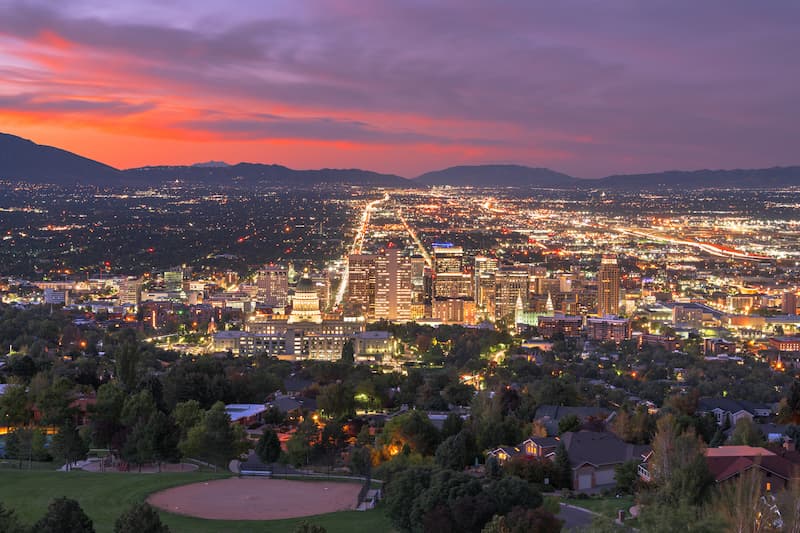
The frenzied home-buying trend is finally starting to cool, but there still aren’t enough single-family homes to meet the rising housing demand.
By 2065, Utah’s population will reach 6.8 million, which is nearly double its current population. This increase in population can have a significant impact on its real estate market. Here are a few potential implications:
Increase in demand: With more people moving to Utah, the demand for housing is likely to increase. This can lead to higher prices for homes, particularly in areas where there is limited inventory. Utah’s median home price has surpassed the $500,000 mark. In January 2019, the median home price was just below $300,000.
Tighter inventory: As more people move to Utah, the supply of homes may not be able to keep up with the demand. This can result in a tighter inventory and make it more challenging for buyers to find a home that meets their needs. In 2021, there was a deficit of 5,500 units in Salt Lake County.
New construction: The increase in demand for housing can lead to more new construction in Utah. Developers may see an opportunity to build new homes, condos, and apartments to meet the growing demand. However, this can also lead to increased competition among builders, and potential issues with overbuilding in certain areas.
Rising rents and mortgages: With more people moving to Utah, the demand for rental properties may also increase. This can lead to higher rental rates for both apartments and houses. The median salary needed to purchase a home will increase as well. Already, Utah has seen a large jump. In 2015, a salary of $70,000 was needed for a median-priced home in Salt Lake County. That figure jumped to $97,000 by the year 2020.Economic growth: The increase in population can also lead to economic growth in Utah. In fact, right now, Utah boasts the nation’s strongest pace of job growth. More people means more jobs, more businesses, and more economic activity. This can create a positive feedback loop where a growing population drives economic growth, which in turn attracts even more people to the area.

Learn about today's mortgage rates. How the Fed, and financial markets affect rates and the housing market.
Mortgage Mike - Co Founder
Read LatestOf course you have questions about buying a home. Let’s get you answers.
 How much will my closing costs be?
We believe in transparency. It depends on a few factors, like credit score, loan amount, and location. You can see an estimated closing cost using our Find Your Best Rate Tool. All without entering any personal information.
YES! It is possible, and it can save you money.
